Artificial intelligence for quality control
Human sensitivity, machine rigor
Artificial Intelligence at QMT
We integrate artificial intelligence algorithms into our solutions primarily so that they can make decisions with criteria obtained through learning; the goal is to preserve human sensitivity while adding the rigor of the machine.
Our expertise covers the selection of suitable models, the creation of datasets for training, data management, and the integration of the created model into a high-speed automated process.
We define the optimal solution to meet specific needs. This approach allows us to perfectly meet the client's expectations with a solution based on a proven standard. This customization can even extend to the creation of a product dedicated to a single client.
Customizable solutions to perfectly meet your needs
measure
Tailor-made solutions designed to meet specific requirements
Tailor-made solutionsThe implementation of Artificial Intelligence for decision-making through learning
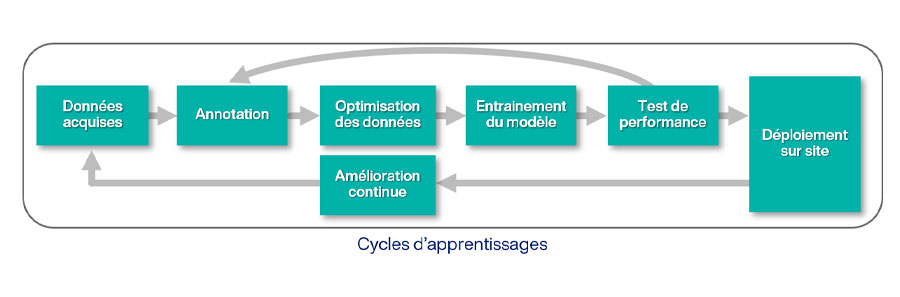
Through our methodology, we handle the definition of the necessary data, the creation of models, the deployment and the improvements.
qmt integrates Deep Learning into its solutions so that systems can make decisions like an operator would (more information on the different AI technologies ).
To meet all needs, QMT integrates several supervised and unsupervised technologies. The QMT team chooses the solution best suited to the application.

Image processing is used in combination with Artificial Intelligence for preprocessing, postprocessing and for checks for which the results are better by traditional algorithms.
We use three sets of images: one set for training, a second set for validation, and a third set for performance testing. Through successive iterations, the training will develop a detection model for each defect and select the one with the lowest error rate. The metrics:
- F1 score: Classification performance metric (details on Wikipedia )
- False Positive (FP): When a non-conforming part is detected as compliant
- False Negative (FN): When a compliant part is detected as non-compliant
Developing a high-performance solution using Artificial Intelligence requires a combination of expertise: data science and AI, but also software development and machine vision . QMT possesses all of these skills.
The performance level achieved depends on the data used for training. We handle the definition of the necessary data, its collection, and selection. Data management is also supported by the standard integrated into our software.
The solutions implemented by QMT guarantee compliance with cybersecurity and data protection requirements. Learning and processing are performed by systems under our control, not in an uncontrolled provider's cloud.
The deployed model can be improved at any time based on the results obtained. QMT offers a structured approach to ensure this process is efficient and controlled. It can be implemented by QMT or by the client.
The requirements of ISO 13485 apply to companies that design control systems for medical devices. Throughout the value chain, QMT products are designed, developed, and manufactured with the aim of being safer and more effective. Particular attention is paid to traceability and risk analysis for the medical sector. The risk analysis is integrated into the product's risk management documentation.
Customized solutions for testing and quality control
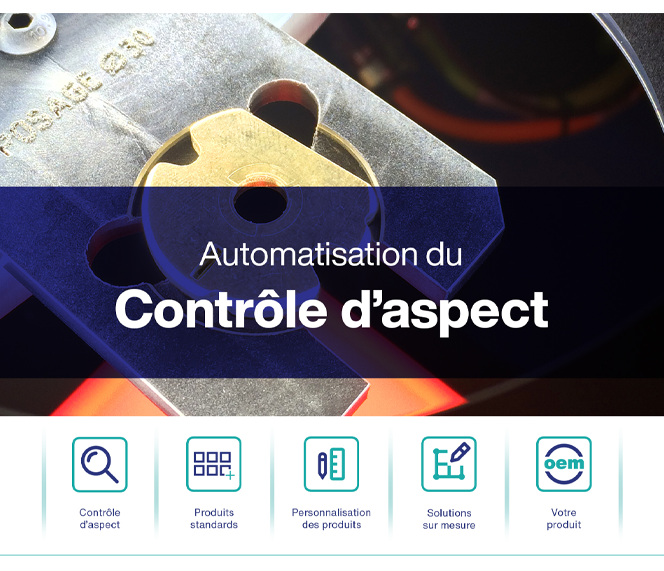
The application of Artificial Intelligence for aspect control
QMT's expertise in implementing solutions
Understanding the client's needs, defining the optimal solution architecture, and integrating the system into the client's environment.
Software development or customizations integrating signal acquisition, processing, communication, and results management
Design and development of Multi-Inspection Mechatronic (M2IS) systems for testing and micromanipulating devices to be controlled
Development and design of innovative optical systems and algorithms to reproduce human vision (3D vision, augmented stereoscopic vision, etc.)
Integration of multi-physics measurements (torque, force, velocity, position, etc.) into systems to enable characterization and automation
Model selection, dataset creation, data management, and integration into an automated process